EvolvIdea
Solo AI SaaS concept · 2026
Project at a glance
- Challenge
- People can start with an idea but lose momentum when structure, validation, and planning are missing.
- Design response
- Replace blank prompts and long AI answers with guided questions and editable blueprint cards.
- Current state
- A concept prototype that moves from rough input to an organised, presentation-ready plan. Usability validation is the next step.
Project details
- Platform
- Web app / AI SaaS
- My role
- Product idea
UX/UI design
AI workflow design
Visual design
Built with Lovable - Team
- Solo project
- Timeline
- Self-directed concept study · 2026
- Category
- Productivity / Ideation / Project planning / AI tool

The design challenge was not generating more content. It was turning each AI response into a visible decision and a useful next step.


Why the problem matters
Early-stage work is often split between notes, AI chats, research tabs, planning tools, and presentation software. The handoffs between them make ideas harder to evaluate and develop.
The opportunity was to shape AI output into a working product structure: visible assumptions, editable decisions, and a plan that can evolve as the idea becomes clearer.
The need
Users need a faster way to move from a vague idea to a clear plan without starting from a blank page or jumping between notes, AI chats, research tools, and presentation software.
The opportunity
Create a guided SaaS experience that transforms ideas into modular cards, action steps, market context, and exportable blueprints, helping users make their project feel real and easier to develop.
From raw idea to project blueprint
EvolvIdea was designed around the moment when an idea exists, but the structure around it is still missing.
01 Raw idea
Users often begin with a simple thought, but the idea is still vague and difficult to explain.
“I have a product idea, but I don’t know how to structure it...”
02 Missing structure
The idea needs an audience, positioning, competitors, features, a roadmap, and presentation logic before it becomes useful.
03 Guided expansion
Smart questions help the user clarify the idea and give the AI enough context to generate a more relevant blueprint.
04 Structured blueprint
The final output becomes modular cards, strategy sections, competitor insights, roadmaps, and exportable presentation material.
Solution
Guided blueprint generation
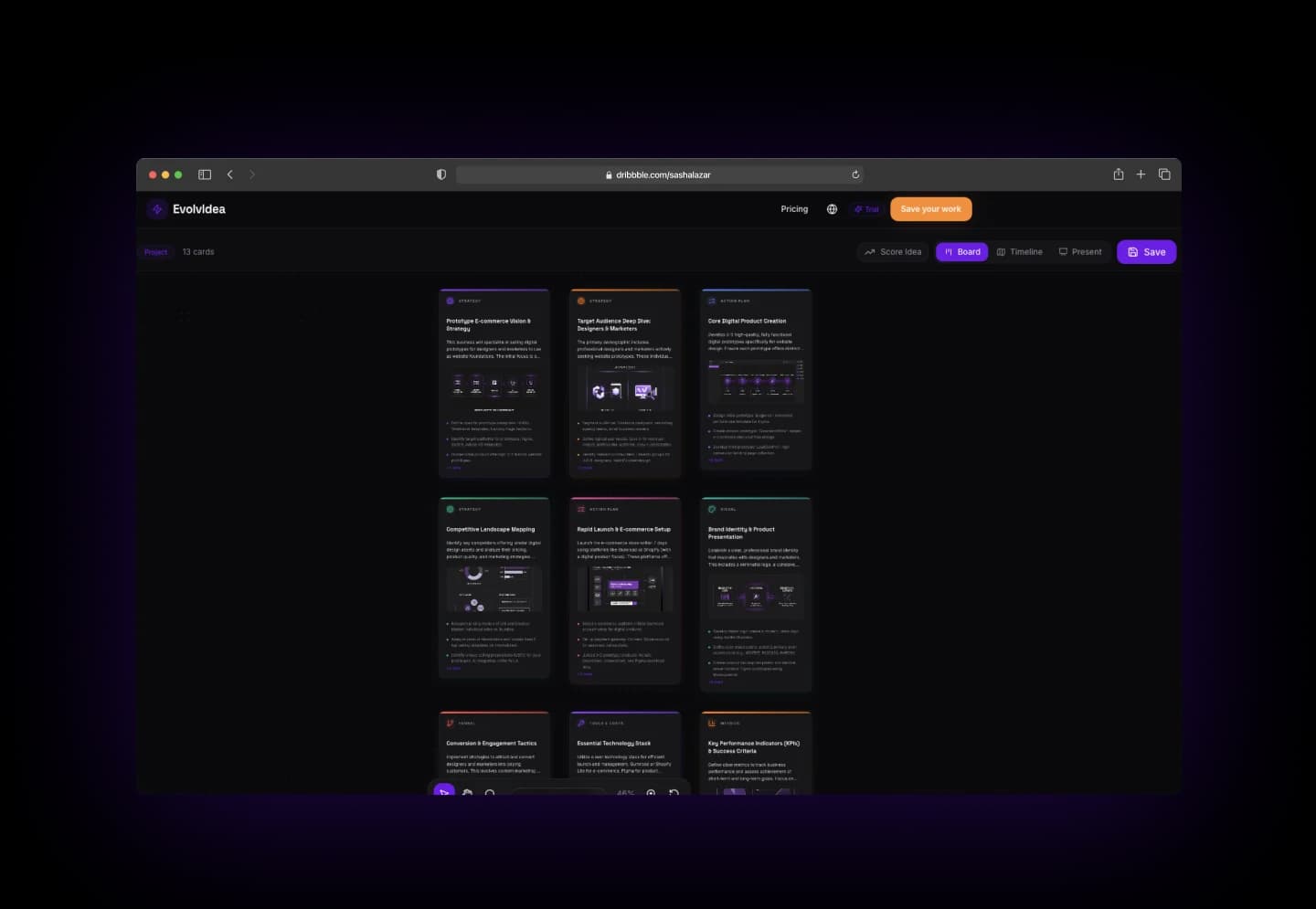
EvolvIdea transforms unstructured ideas into guided, modular blueprints by combining AI questions, card-based planning, market research, timelines, and export tools inside one visual workspace.
- ✓Smart questions clarify the idea before generation.
- ✓Blueprint cards organize strategy, market, roadmap, and actions.
- ✓The output can be arranged visually and prepared for presentation.
Research
AI is everywhere in 2026, but raw AI answers are not enough. Users still struggle to move from a vague idea to a structured, validated, and presentation-ready plan.
EvolvIdea is not useful because it “generates ideas.” It is useful because it turns messy thinking into a guided blueprint: questions, strategy cards, audience, competitors, risks, roadmaps, and exportable output.
1. AI adoption is high, but structure is missing
Microsoft’s 2026 Work Trend Index shows that AI is already used for analysis, decisions, problem-solving, and creative thinking. The challenge is no longer access to AI, but how work is designed around it.
2. AI output needs human direction
Microsoft also found that 86% of AI users treat AI output as a starting point, not a final answer. Users still need to evaluate, edit, organize, and own the result.
3. Chat is powerful, but not always usable
Nielsen Norman Group describes AI as an intent-based interface. Chat can still be hard to control, too text-heavy, and unreliable when users need a clear, actionable result.
4. The AI gap is now management and validation
The 2026 AI Index shows that AI is advancing faster than the systems built to evaluate, govern, and manage it.
What it means for EvolvIdea
Users already have access to many AI tools, but they still need help turning AI output into something clear, organized, and usable. EvolvIdea acts as a guided blueprint system: it asks focused questions, breaks results into editable cards, highlights risks and assumptions, creates a roadmap, and helps users turn an early idea into a practical plan.
User flow
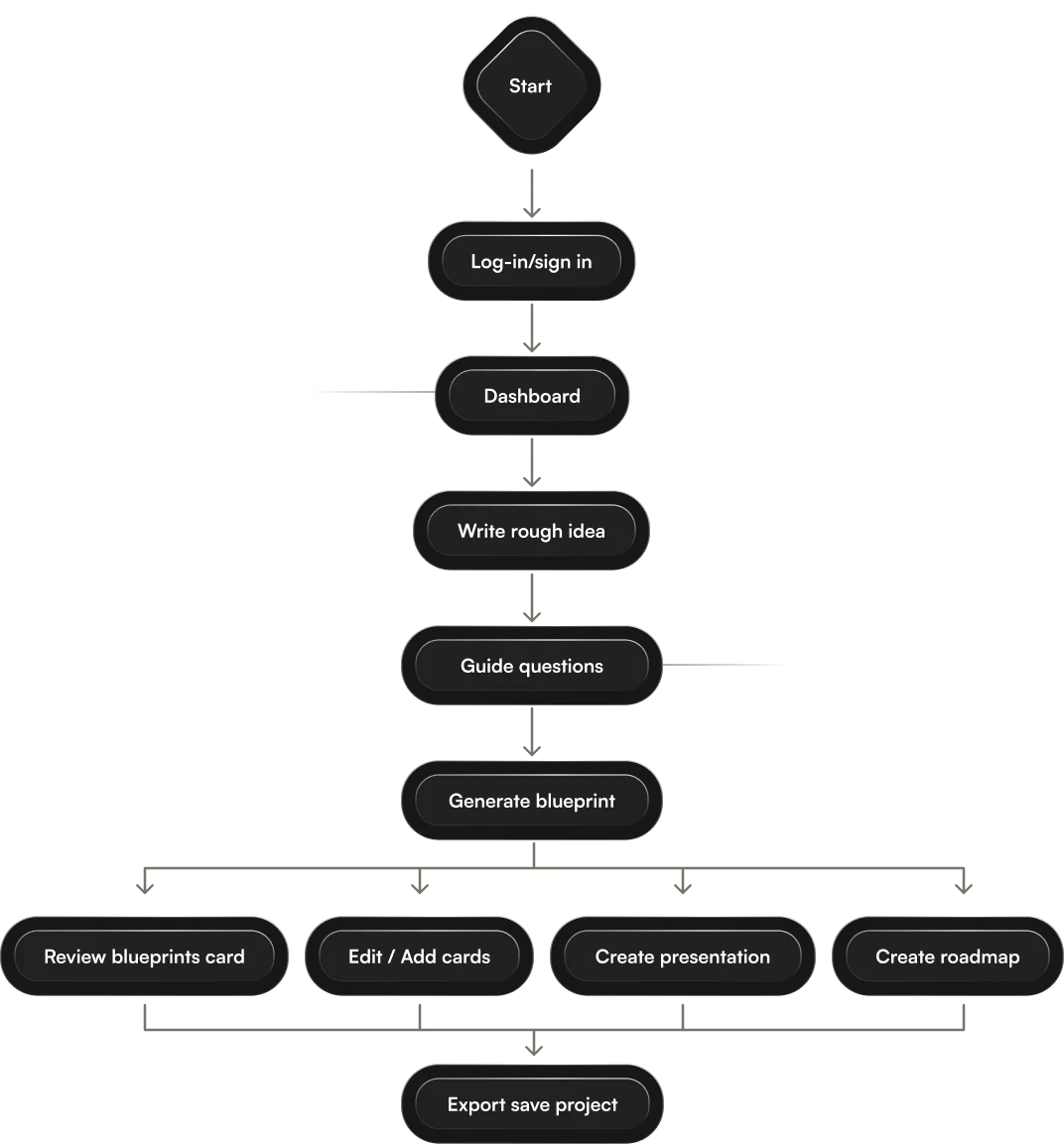
The flow maps how a user moves from an unstructured idea to a generated blueprint using guided questions, AI output, editing, and export.
The flow reduces the blank-page problem. Instead of expecting users to know exactly what to prompt, EvolvIdea guides them step by step until the idea becomes organized and actionable.
From idea to blueprint
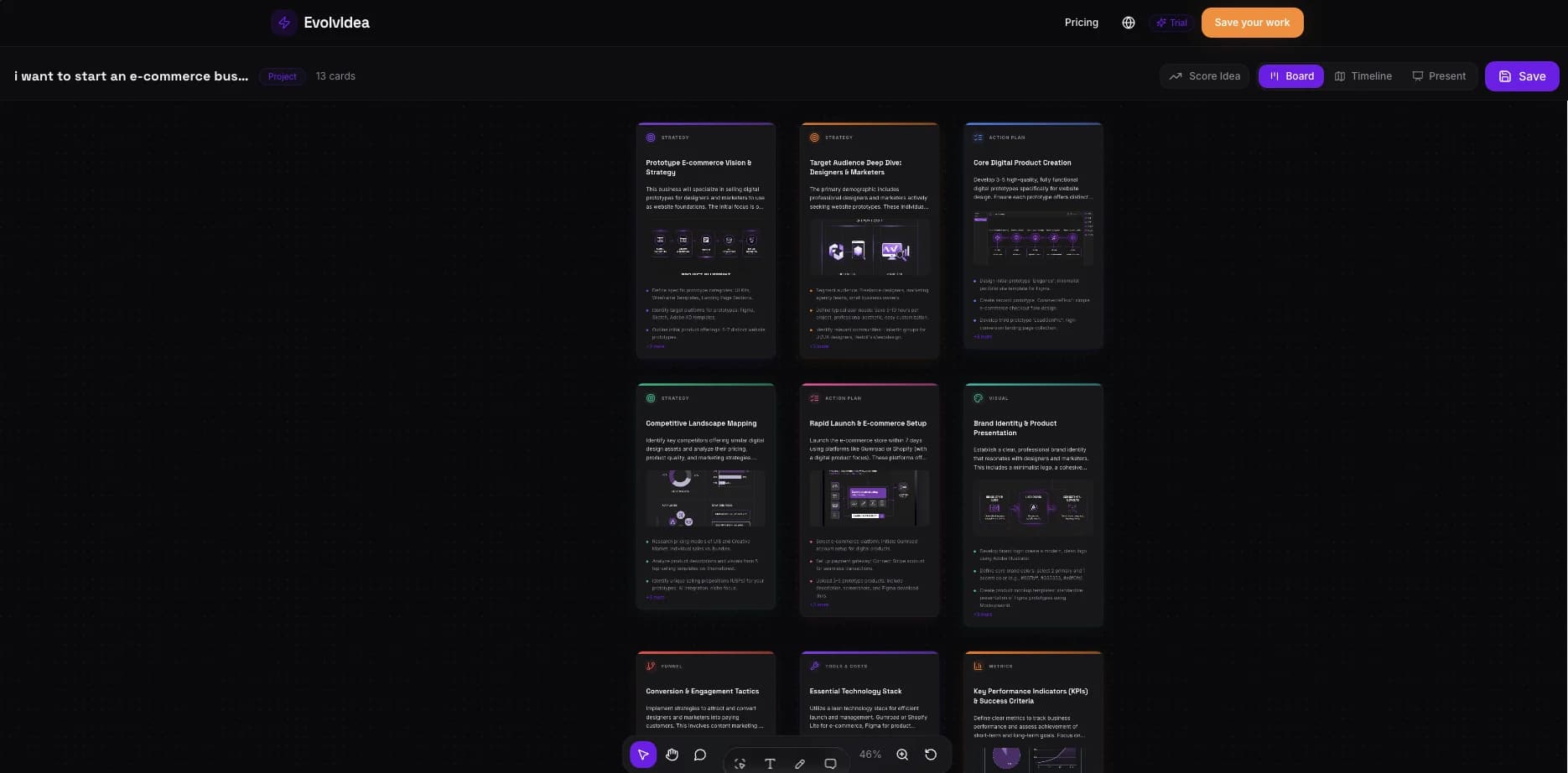
The main interactions guide users from a rough thought to a structured output. Each step reduces uncertainty: first by making it easy to start, then by clarifying the idea, and finally by turning the result into editable cards.
Users can begin with an unfinished thought instead of a perfect prompt. This lowers the pressure of starting and makes the product useful even when the idea is still vague.
Before generating the blueprint, EvolvIdea asks focused questions about the project type, audience, goals, and context. This helps the AI understand the idea and produce a more relevant result.
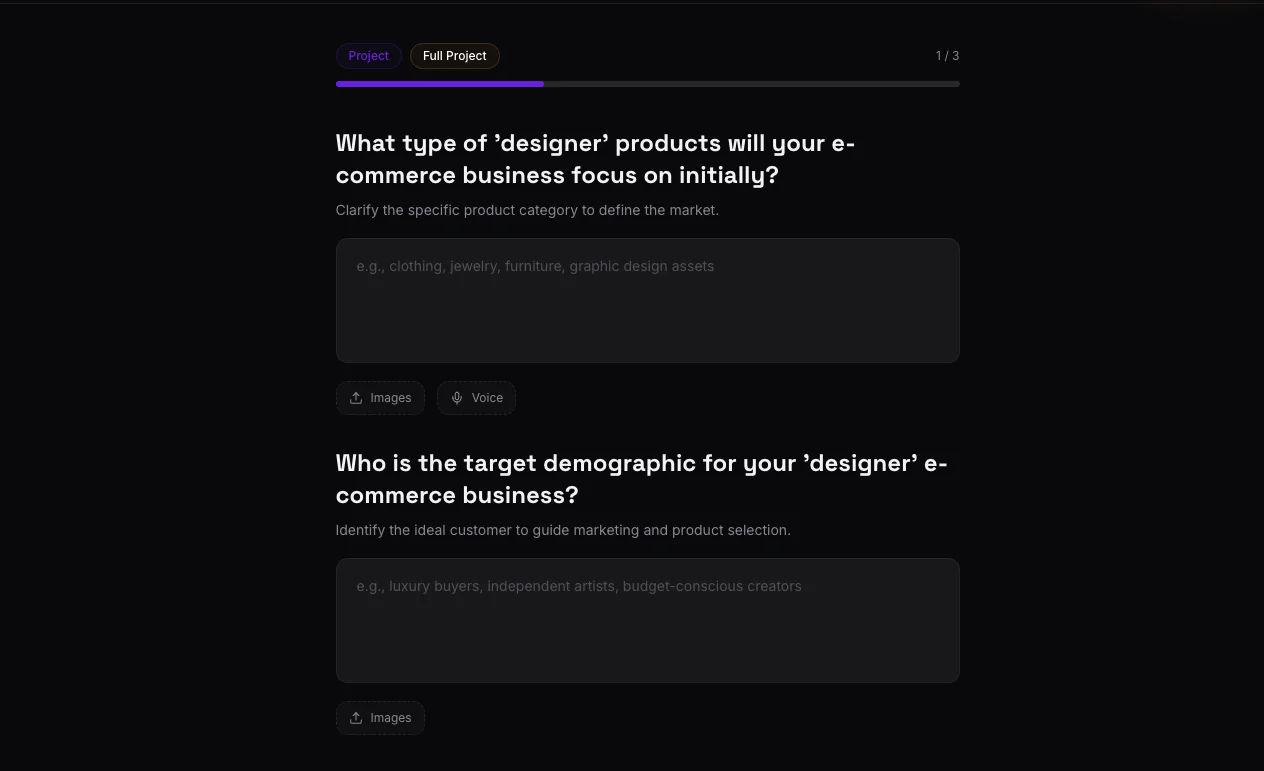
Before starting the blueprint, users review what they want to achieve and confirm the information that will help the AI connect the dots.

The generated result is divided into modular cards so users can review, edit, move, and refine the output. This turns AI from a one-time answer into a workspace for thinking and planning.
Visual design
Colour & mood
The visual direction uses a dark interface with purple highlights to communicate AI, structure, and focus. Orange is reserved for primary actions so generation and export moments stand out clearly.
#FA8938
#0C0C0C
#F7F5F0
#8A38F5
#6419E6
Typography
The typography feels modern, clear, and product-focused. Strong headings make the SaaS feel confident, while smaller interface text keeps the experience practical and easy to scan.
Space Grotesk
Titles · 64px / 48px / 40px
Satoshi
Labels · 24px / 16px / 12px / 8px
Landing page
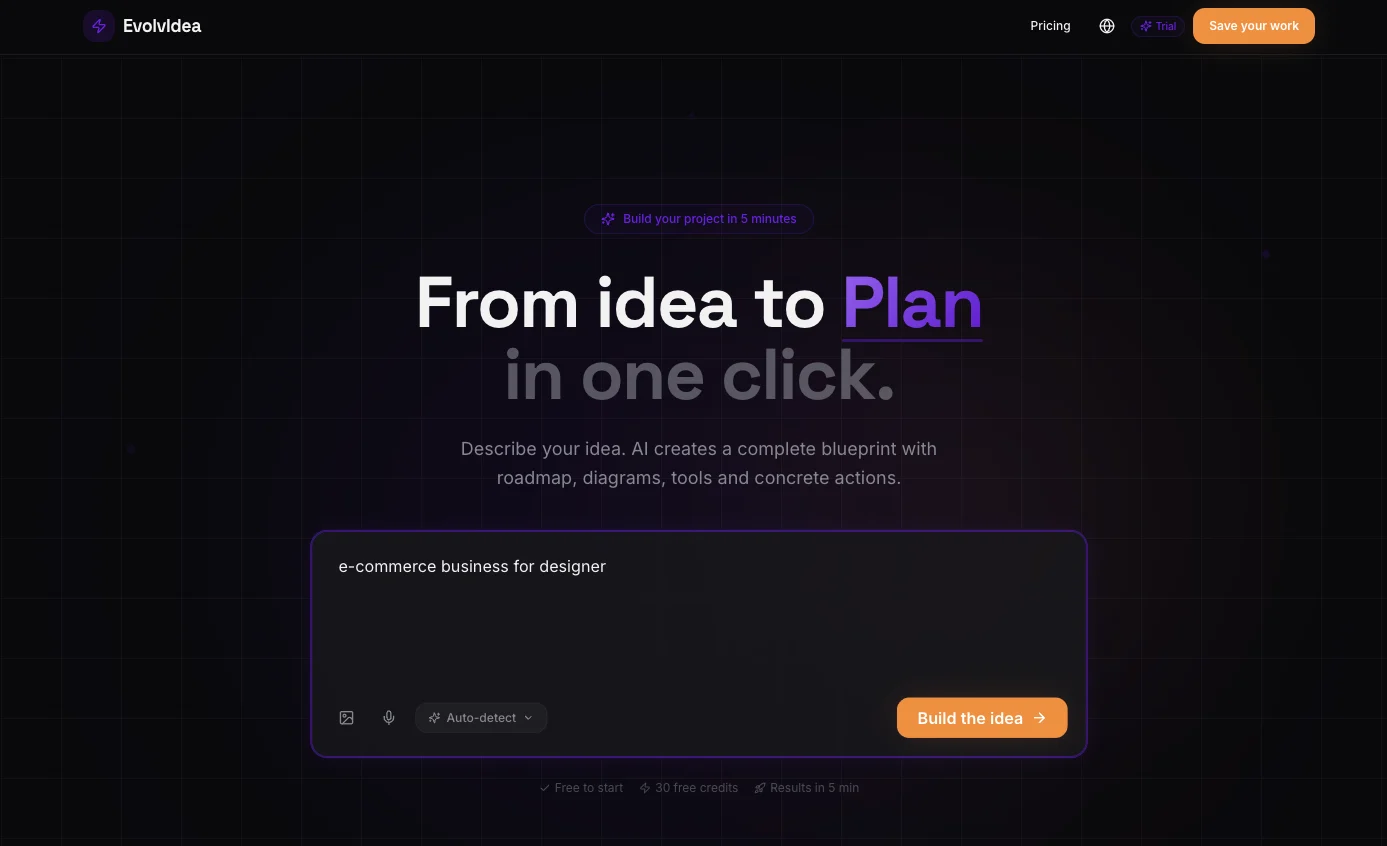
The landing page is the first entry point. Its role is to communicate the promise quickly: users can start from a rough idea and turn it into a structured blueprint.
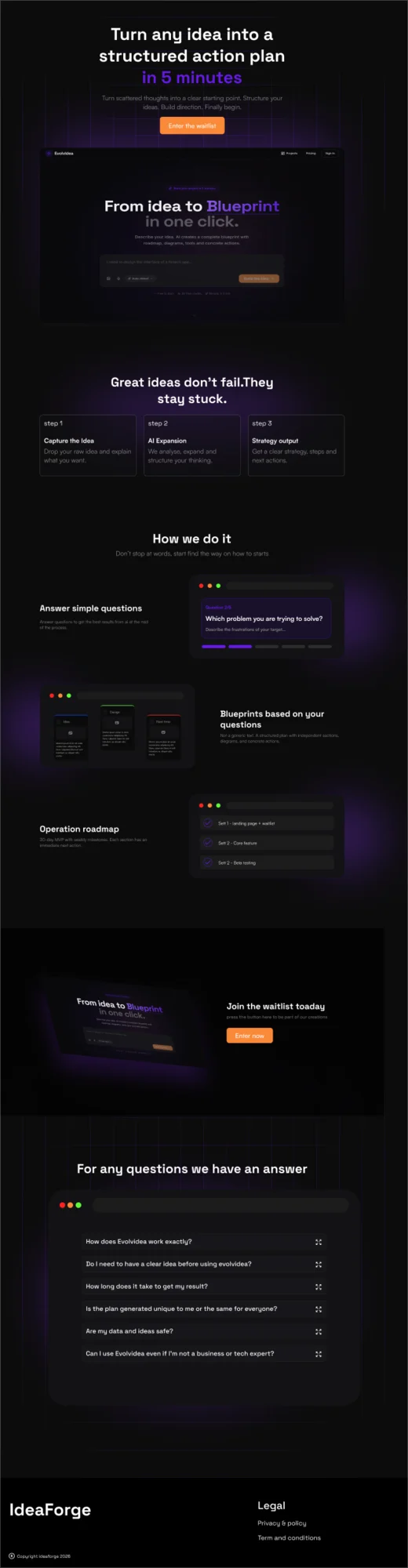
From rough idea to clear blueprint, EvolvIdea turns thinking into structure.
EvolvIdea was created to close the gap between having an idea and knowing what to do with it. By combining guided questions, AI-generated sections, modular cards, and export-ready outputs, the product helps users move from vague thinking to a clearer and more actionable plan.
Key takeaways
Structure creates momentum
Users do not only need more AI answers. They need a system that organizes ideas, reveals priorities, and helps them move forward.
Guidance improves the output
Focused questions before generation help the AI understand the project and make the final blueprint more relevant.
Editable results build trust
Modular cards let users review, change, and shape the result into something they can actually use.
Continue exploring
Next case study
Mobile travel app · UX/UI design
Romly
A personalised travel experience that helps people move from inspiration to confident activity booking.
Looking for a product designer?
I’m interested in thoughtful product teams, UX/UI roles, and collaborations where clear thinking and strong visual craft matter.